



Dental Implant Survival Rate in Patients with Pathologic Sinus Conditions
Dental implants became a standard treatment for missing teeth in the posterior maxillary area. . However, the presence of pathologic sinus conditions present unique challenges to the placement and survival of these implants placed in combination with grafting materials, especially in the maxillary posterior region where the sinuses are anatomically close to the alveolar ridge. Pathologic conditions such as chronic sinusitis, sinus cysts, and other infections of the maxillary sinus can increase the risk of complications following implant surgery. Therefore, understanding how these conditions impact implant success rates is critical for optimizing treatment planning and patient outcomes.
1.2 Anatomy and Pathology of the Maxillary Sinus
The maxillary sinuses are located in close proximity to the upper jaw. Understanding the anatomy and function of the maxillary sinus, including its size, position, and variability, is crucial for assessing the impact of pathologic conditions on implant success. The maxillary sinus has a volume in average of 15ml with an average length of 3.5cm ,3.5cm in height and 2.5ml in width with an average volume of 3.5ml . Its function is to humidify the air, lighten the skull as well in voice resonance as well it delivers physical protection against trauma. The outline can be described as pyramide which has its apex directing to the zygomatic bone.. The arterial supply is secured by the infraorbital and posterior superior alveolar artery which origins from the maxillary artery(external carotis artery) and from an anastomosis.
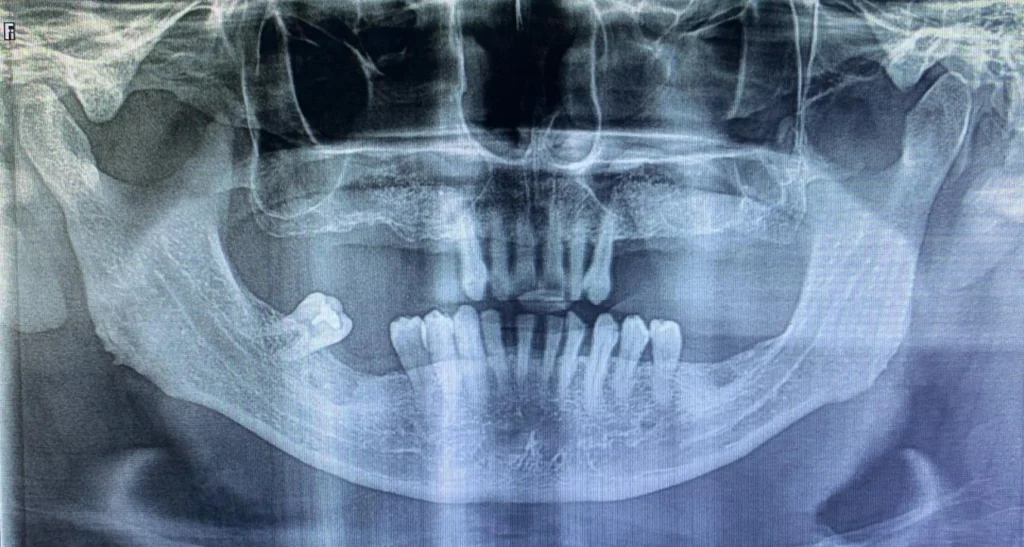
The sinus is divded into 6 walls wherein the thickness of the lateral wall of the maxillary sinus ranges in average from 0.95 mm in edentulous patients to 1.31mm in partially dentolous patients. The blood supply to the sinus is derived from the maxillary artery. Branches of the maxillary artery which include the posterior superior alveolar artery and infraorbital artery form endosseous and extraosseous anastomoses in the sinus along with the blood vessels of the schneiderian membrane.
1.3 Sinus Pathologies
Sinus pathologies have a high prevalence Up to 45% of examined persons to undergo sinus lifting showed symptoms of sinusitis. Additional risk factor to develop sinusitis would be smoking: Smoking has several negative effects when it comes to sinus pathologies. The reduced ciliary movements of smokers decrease the removal of mucous, therefore increase the risk of sinus infections. As well smoking is believed to interfere with bone graft healing because it reduces local blood flow (
Sinus pathologies:
⦁ Foreign Bodies
⦁ Acute Rhinosinusitis: duration would be less than 3 months
⦁ Chronic Rhinosinusitis
⦁ Fungal Rhinosinusitis
Allergic Rhinosinusitis
⦁ Mucous Cysts
Mucocele: mucous accumulation due to fibrous blockage of the ostium
⦁ Polyps: These benign growths caused by allergies within the sinus cavity obstruct(mucous airflow and mucous drainage) the paranasal sinuses, function as bacterial retention sites and therefore affect the sinus.
⦁ Sinus retention cysts(pseudocysts): They appear below the periostium, not surrounded by epithelium, nevertheless lined by connective tissue. Usually they dont affect the outcome, nevertheless if they size more than 50 % of the sinus(blocakage of ostium), they can block the ostium. Nevertheless the fluid of the sinus retention cyst can diffuse into the grafting right after placement. The soaked grafting can then be hindered to further soak blood therefore a graft failure can be the result due inihibited bone formation.
⦁ Neoplasms: benign or maligne
- Objective of the Study
The objective of this thesis is to assess the survival rates of dental implants in the sinus region in combination with grafting , placed in patients with various pathologic sinus conditions, identify risk factors associated with implant failure, and provide evidence-based recommendations for managing these patients to improve implant success.

Dental implants have become a standard treatment for replacing missing teeth in the posterior maxillary area. However, certain anatomical and pathological conditions, such as sinus pathologies, may pose challenges for the success and survival of these implants. This thesis explores the impact of pathologic sinus conditions on the survival rate of dental implants placed in this region with and without sinus augmentation.

It presents a comprehensive review of existing literature, focusing on conditions such as chronic sinusitis, sinus cysts, and sinus floor infections, and evaluates how these conditions influence the long-term success and failure of dental implants. The aim is to identify key factors that contribute to the risk of implant failure and to provide insights into management strategies that could improve the outcomes in patients with pathologic sinus conditions.
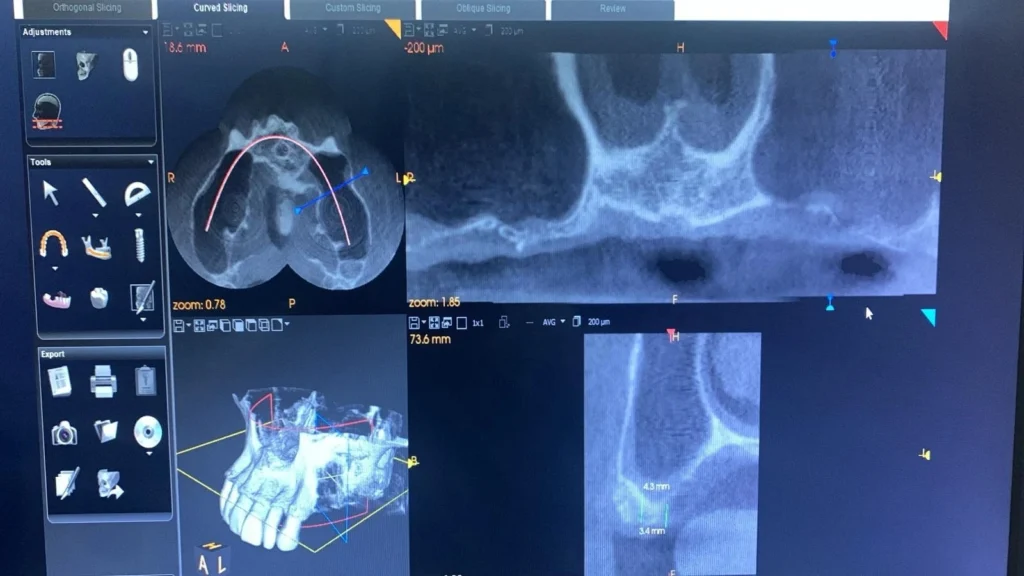
2.1 Research Question:
⦁ How do chronic sinus conditions, such as acute sinusitis, chronic sinusitis , sinus cysts or any kind of pathology affect the survival rate of dental implants?
Study number 1: This paper includes several case reports, wherein case number is 2 relevant for this study:
A 54-year-old male patient presented with a malformed bridge on the right posterior of the maxilla. The patient did not have any specific medical history but had a history of chronic sinusitis and modified endoscopic-assisted sinusitis surgery (MESS) on the left maxillary sinusitis. Noticeably, his alveolar bone height in the maxillary right posterior area was extremely atrophied due to pneumatization of the sinus and prosthesis malfunction. The patient was managed with bridge cutting, sinus lifting, and bone grafting (Oragraft®; LifeNet Health Co., Virginia Beach, VA, USA), and two bone-level 4.0 × 8.5-mm Luna® implants (Shinhung Co., Seoul, Korea) were installed in the #15 and #16 positions. Roughly 2 weeks after surgery, the patient reported the presence of a bad smell and exudate that had begun 10 days after surgery. An intraoral examination confirmed the mobility of both implants. With a panoramic view, displacement of a portion of grafted bone inside the sinus was observed
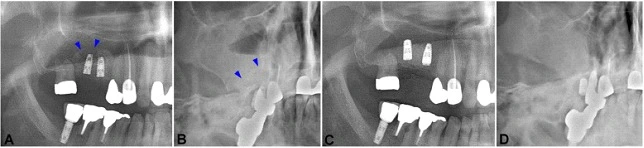
A panoramic view 2 weeks after implant installation in case 2. There was a displacement of grafted bone, and the implant apex was exposed to the sinus cavity (A blue arrowheads). The mucosal thickness and fluid level were made apparent using Water’s view (B blue arrowheads). The panoramic view and Water’s view after implant reinstallation showed good bone integration and a clear sinus (C, D)
Study number 2: In total, 109 patients (121 sinuses, 252 implants) were included in this study. The correlation between postoperative infection and implant loss and clinical variables was assessed using logistic regression analyses.
Chapter 4: Results and Discussion
Study 1: The bad smell and exudate the patient experienced is a strong that a bacterial contamination of the graft material was involved. Besides graft particles were found in the sinus, conclusion would be that there was a sinus perforation which possibly triggered the failure.
Study 2: Results Postoperative infection and implant loss occurred in 8/121 sinuses (6.6%). Infection had the strongest correlation to preoperative chronic sinusitis (p = 0.007), followed by timing of implant insertion. Implant loss had the strongest correlation to preoperative chronic sinusitis (p = 0.007), followed by sex, diabetes, postoperative use of dentures, and intraoperative perforation of the sinus membrane
4.2 Analysis of Implant Survival Rates:
Postoperative infection and implant loss occurred in 8/121 sinuses (6.6%). Infection had the strongest correlation to preoperative chronic sinusitis (p = 0.007), followed by timing of implant insertion. Implant loss had the strongest correlation to preoperative chronic sinusitis (p = 0.007), followed by sex, diabetes, postoperative use of dentures, and intraoperative perforation of the sinus membrane
5.1.Discussion& Conclusion
Despite the small amount of studies and case reports, its evident that theres a relationship in between sinus pathologies and implant survival. Unfortunately study 1 couldnt be included in my conclusion because of the problems mentioned above. Preoperative chronic sinusitis could be a significant cause of postoperative infection and implant loss when using sinus augmentation from a lateral approach. For appropriate prophylaxis and therapy, it is necessary to diagnose the presence of chronic sinusitis that should be treated with proper methods prior to sinus augmentation.