

Tenting Screws in Implant Dentistry
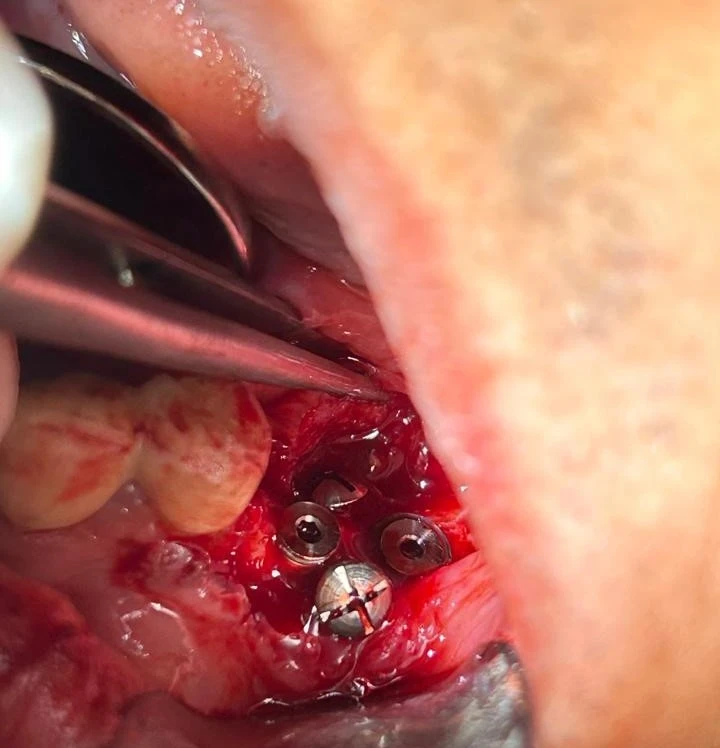
Tenting screws are specialized tools to facilitate GBR by preventing the periosteum from lying on the grafting material directly. They act as stable space maintainers to allow bone growth in vertical and horizontal dimensions. Most tenting screws are made of medical steel, which prevents them from osseointegrating and facilitates the removal once the bone underneath matures.
Applications of Tenting Screws
⦁ Alveolar Ridge Augmentation
Tenting screws are frequently used in cases where the alveolar ridge has lost size in vertical and/or horizontal dimension. They help rebuild the ridge to provide sufficient bone volume for implant placement.
⦁ Vertical Bone &Horizontal Bone Augmentation
In cases of vertical bone deficiencies, tenting screws are used to help rebuild the height of the ridge, serving as “tent poles” in case graft material is used, and ensuring that the regenerated bone matches the required implant dimensions.
How do Tentings screws work?
Tenting screws act similarly to tent poles, preventing the periosteum from compressing the grafting material and therefore creating a space that is essential for osseointegration. This space allows the grafting particles to stay in a definite position, which is necessary for angiogenesis, the formation of new blood vessels, and the formation of osteoid and woven bone, the precursor of mature bone.
Initially, mostly type 1 and smaller amounts of type 5 collagen and non-collagenous proteins, such as osteopontin and osteonectin, are formed, along with proteoglycans.

Procedure Overview
⦁ Planning and Placement
The surgical site is prepared with careful attention to the defect dimensions. Tenting screws are strategically placed into the remaining bone to ensure they support the grafted material in the desired position.
⦁ Graft Application
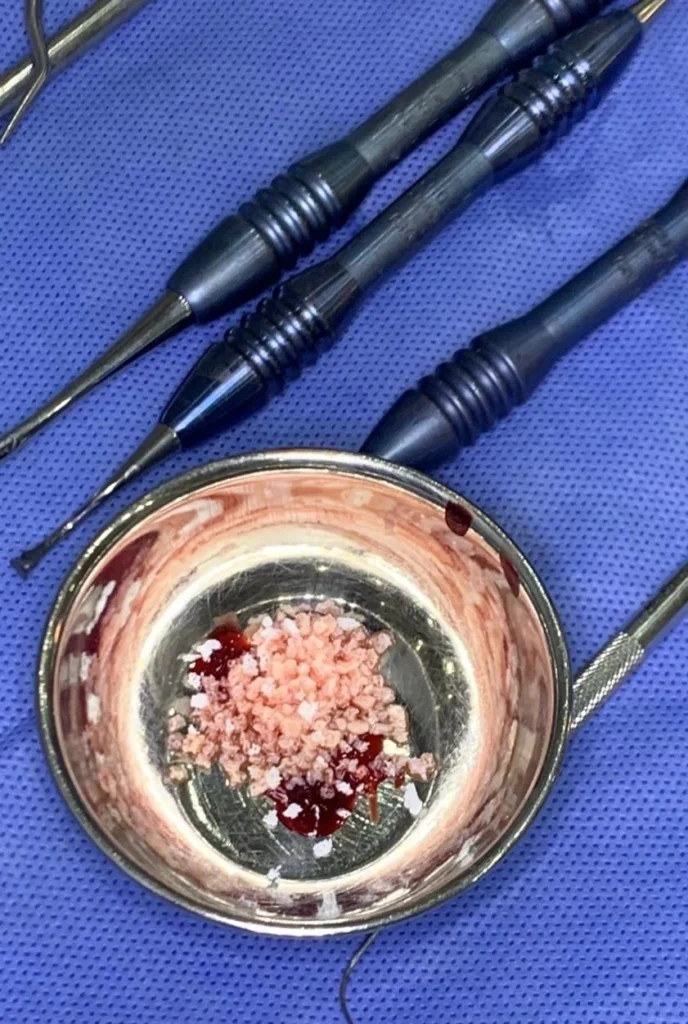
Bone graft material—autogenous, allograft, xenograft, or synthetic—is packed around the screws. The screws hold the graft in place and maintain the desired shape of the augmented area.
⦁ Membrane Coverage
A barrier membrane is used to cover the grafted area and screws, preventing soft tissue infiltration and supporting guided bone regeneration. Long-standing membranes, such as cross-linked or collagen membranes, are used.
⦁ Wound Closure
One of the most important factors for the success of the surgery is a tension-free closure of the surgical site.
Advantages of Tenting Screws
⦁ Space Maintenance: Ensures adequate room for bone regeneration.
⦁ Stability: Provides mechanical support for the graft material.
⦁ Cost-Effective: Compared to other advanced bone augmentation techniques, tenting screws are relatively economical. The price for tenting screws is low, and they can be reused after being autoclaved.
⦁ Versatility: Useful in a wide range of defect types, 3d augmentations.
⦁ Complication rate: The complication rate is lower than with PTFE membranes [1]
Challenges
⦁ Surgical Skill: Proper placement of tenting screws doesn’t require the highest level of surgical skill and experience therefore, also relative beginners are suitable to use this technique..
⦁ Soft Tissue Management: Ensuring tension-free closure is critical to prevent wound dehiscence and exposure of the graft or screws.
⦁ Post-Operative Care: Careful monitoring and maintenance are essential to avoid complications such as exposure of screw heads.
⦁ Screw Removal: Once bone regeneration is completed, screws may need to be removed either after opening a flap or directly in case the heads are visible throughout the periosteum and soft tissue. The removal of the screws isn’t that challenging in case they are made of steel because steel doesn’t tend to osseointegrate.
Conclusion:
Tenting screws are a a highly efficient tool in implant dentistry for addressing challenging bone defects. By creating a fixed space, they ensure the predictability of bone augmentation procedures. Tenting screws are likely one of the most cost-efficient and technically straightforward methods for augmenting bone in vertical, horizontal, or 3-dimensional applications. They are advantageous compared to conventional GBR methods, specifically for ridgewidths 3mm below crest level. [2] Practitioners can combine PTFE membranes for a higher predictability in vertical augmentative procedures.
Sources:
1. How Effective Is the Tent Screw Pole Technique Compared to Other Forms of Horizontal Ridge Augmentation?
- June 2017
- Journal of Oral and Maxillofacial Surgery 75(10)
- DOI:10.1016/j.joms.2017.05.037
- Authors: George R. Deeb